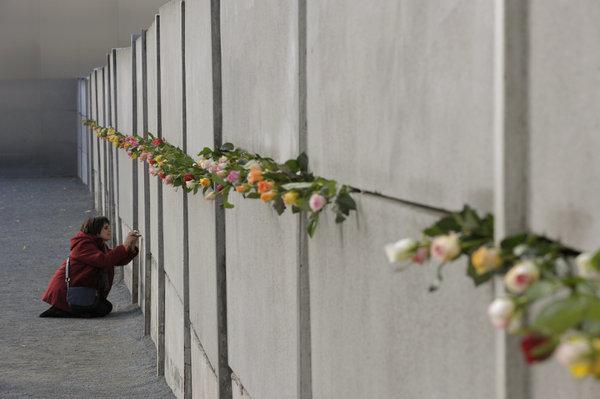
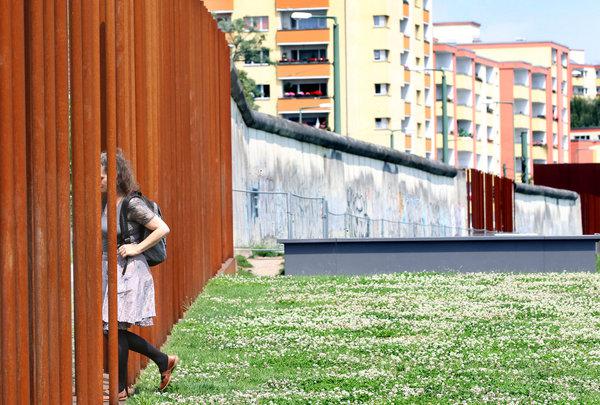
On Bernauer Strasse, the border ran straight through a row of houses, from whose windows people jumped into West Berlin. Today, the Berlin Wall Memorial stretches over 4.4 hectares and 1.4 kilometers, featuring the only section of border fortifications preserved in full depth. The Window of Remembrance names the 132 civilian victims.
Berlin Wall Memorial: 1.4 Kilometers on the Border Strip
Bernauer Strasse was no ordinary street. It separated Wedding in the west from Mitte in the east, and the houses on the east side opened their windows to West Berlin. This is precisely where the Berlin Wall Memorial now stretches over 4.4 hectares and 1.4 kilometers between Gartenstrasse and Schwedter Strasse. The core of the area is a roughly 70-meter-long section of the border strip, enclosed by two high steel walls, which was inaugurated as a national monument on August 13, 1998. It includes an identically reconstructed watchtower, which shows how the installations were built at the end of the eighties.
Rust-red Corten steel marks in the ground what no longer stands: demolished border houses, vanished barriers, and the routes of escape tunnels. Exposed cellar rooms and archaeological windows make the underground visible. It was at this spot that Ida Siekmann died on August 22, 1961, jumping from the window of Bernauer Strasse 48. A few days earlier, the photograph of border policeman Conrad Schumann jumping over barbed wire was taken here, and on the night of November 10-11, 1989, the first segments of the wall were broken out on this street.
Window of Remembrance, Chapel of Reconciliation and Documentation Center
The Window of Remembrance lists the names, dates of birth and death, and, where available, portraits of the 132 civilian victims of the Berlin Wall. The eight killed border soldiers are named on a separate stele on the patrol path. A few steps away stands the Chapel of Reconciliation, which Peter Sassenroth and Rudolf Reitermann erected in 2000 on the foundations of the Reconciliation Church, blown up in 1985. Its interior wall is made of rammed earth, into which the rubble of the destroyed church was incorporated.
In the Documentation Center at Bernauer Strasse 111, the permanent exhibition tells the story of the Wall’s construction, everyday life in the divided city, and the fall of the Wall. From the observation tower above, the border strip can be viewed from above, and a digital tour guide leads to more than 140 event markers on the site. Admission to the Berlin Wall Memorial is free; a public guided tour costs 5 Euros, or 3 Euros reduced.

Top10 Redaktion
Erfahrungsbericht vom 22.10.2026
Price Level
Admission is free. A public guided tour costs 5 Euros, reduced 3 Euros.
Public Transport
S1, S2, S25 and S26 as well as Tram M10 to S-Bahnhof Nordbahnhof, U8 to Bernauer Straße, U6 to Naturkundemuseum, Bus 247 to Nordbahnhof/Gartenstraße.
Parking
No regular visitor parking. Two disabled parking spaces behind the visitor center with access via Gartenstraße, two more on Ackerstraße. Tour buses stop on Ackerstraße.
Accessibility
Visitor center, documentation center, and seminar rooms are barrier-free. Wheelchairs, mobile seating, and walking sticks can be borrowed free of charge.
Highlight
The Window of Remembrance displays names, dates of birth and death, and, where available, photos of the 132 civilian victims of the Berlin Wall.
Extent
4.4 hectares of memorial landscape over 1.4 kilometers between Gartenstraße and Schwedter Straße.
Opening Hours
- Monday: Closed
- Tuesday: 10:00–18:00
- Wednesday: 10:00–18:00
- Thursday: 10:00–18:00
- Friday: 10:00–18:00
- Saturday: 10:00–18:00
- Sunday: 10:00–18:00
Address
Bernauer Straße 119, 13355 Berlin, Deutschland
http://www.berliner-mauer-gedenkstaette.de/de/besucherzentrum-560.html