Parlament der Bäume
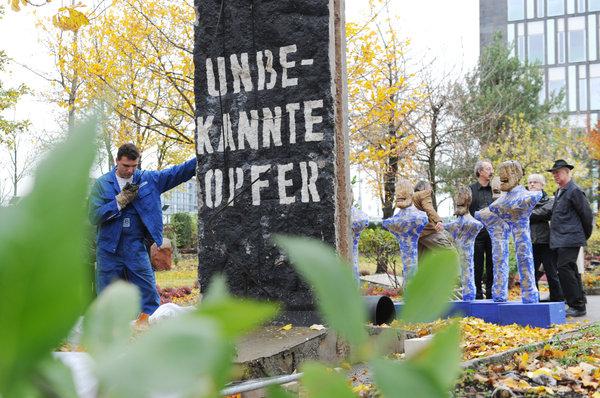
On approximately 2,850 square meters in the government district, Ben Wagin established the Parliament of Trees on the former border strip in 1990. A square of 16 trees was planted by the state premiers, and the names of 258 victims of the border regime are inscribed on granite slabs. Among the Berlin Wall sites, this is the greenest.
Parliament of Trees: Ben Wagin’s Garden on the Death Strip
In the government district, between the Spree embankment and the Federal Press Conference building, lies an unusual memorial covering approximately 2,850 square meters. The nature and art activist Ben Wagin established the Parliament of Trees in 1990, immediately after the fall of the Wall, on the former border strip, using original Wall elements and his own plantings. At its heart is a square of 16 trees planted by the state premiers of the old and new federal states. Among them are memorial stones, flower beds, sculptures, murals, and implied grave fields.
Wagin had already begun planting trees in West Berlin in 1979 wherever the Wall cut off a street. His engagement with the border dates back to 1961 when he participated in a sculpture symposium in the Tiergarten, the very first artistic work related to the Berlin Wall. In the Parliament of Trees, ginkgo trees stand as a symbol of hope. Wagin continued to work on the site until his death in 2021, understanding it as a growing work that should never be finished. The site is fenced and accessible through a gate.
258 Names on Granite and the Continuation in the Lüders House
The names of 258 victims of the border regime are recorded on granite slabs. This number reflects the knowledge available in 1990 and differs from the at least 140 scientifically investigated victims, as pointed out by the Berlin Wall Foundation itself. In the northern part of the site, images and quotes against war and violence can be found; in the southern section, an annual calendar records the number of victims per year. It also commemorates the Soviet soldiers who were shot here after the storming of the Reichstag on April 20, 1945.
The area was significantly reduced for the construction of the Marie-Elisabeth-Lüders-Haus. A section of the Wall designed by Wagin has since stood in the basement of the Bundestag library, inscribed with years and the respective determined number of victims. This Wall memorial was opened in September 2005. Since summer 2021, the Berlin Wall Foundation has been in charge of the memorial site. Admission is free, a public tour costs 5 Euros, and a reduced ticket is 3 Euros.

Top10 Redaktion
Erfahrungsbericht vom 22.10.2026
Preisniveau
Admission is free. A public guided tour costs 5 Euros, reduced 3 Euros.
Saison
The memorial site is only open during the summer half-year. The site is fenced and not accessible outside of the season.
ÖPNV
U5 to Bundestag, U6 and S3, S5, S7, S9 to Friedrichstraße. Bus 245 stops at Karlplatz, buses 147 and M41 at Schumannstraße.
Parkmöglichkeiten
There are no designated visitor parking spaces in the government district. Traveling by train and bus is the easier option.
Barrierefreiheit
The gate is wheelchair accessible, the front part of the site is barrier-free. The path is slightly sloping, there is no toilet.
Highlight
The square of 16 trees on the Spree embankment was planted in 1990 by the state premiers of the old and new federal states.
Fläche
Approximately 2,850 square meters on the former border strip opposite the Reichstag.
Opening Hours
- Montag: Closed
- Dienstag: Closed
- Mittwoch: Closed
- Donnerstag: 12:00–17:00
- Freitag: 12:00–17:00
- Samstag: 12:00–17:00
- Sonntag: 12:00–17:00
Address
Schiffbauerdamm 1, 10117 Berlin, Deutschland
https://www.stiftung-berliner-mauer.de/de/parlament-der-baeume