Nationaldenkmal auf dem Kreuzberg

In Viktoriapark, on the 66-meter-high Kreuzberg, stands Schinkel's cast-iron National Monument for the Liberation Wars, inaugurated in 1821 and later raised onto an eight-meter-high plinth. From its platform, the view extends over the roofs of Kreuzberg to the city center. The ascent leads past the 24-meter-high waterfall and costs nothing.
National Monument on Kreuzberg: Free View in Viktoriapark
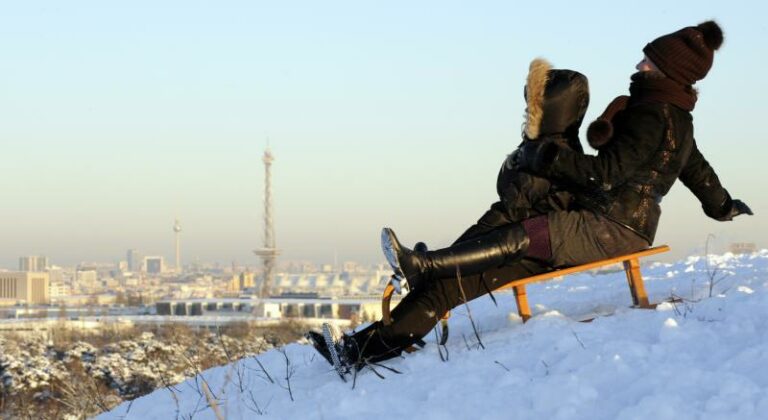
At 66 meters, Kreuzberg is the highest natural elevation in the inner city, and at the very top of Viktoriapark stands the National Monument for the Liberation Wars. Karl Friedrich Schinkel designed it between 1817 and 1821, and it was inaugurated on March 30, 1821, the anniversary of the Allies’ entry into Paris. Except for a small brick core, the monument is entirely made of cast iron, including the twelve larger-than-life figures representing the most important battle locations. Between 1875 and 1878, the entire monument was hydraulically lifted, placed on an eight-meter-high granite and sandstone plinth, and rotated towards Großbeerenstraße. A two-armed grand staircase leads to the platform on this plinth. From there, the view extends over the rooftops of Kreuzberg to the north into the city center and to the west along Monumentenstraße towards Schöneberg. Visiting is free, as Viktoriapark is a public green space and the monument is freely accessible. This makes Kreuzberg one of the few high points in the city for which neither a ticket nor a time slot is required.
Waterfall, Park History and Directions to the Kreuzberg Monument
The ascent is part of the experience at the National Monument on Kreuzberg. Viktoriapark was designed between 1888 and 1894 according to plans by garden director Hermann Mächtig and is considered the only almost completely preserved Berlin city park from the Historicism era. Its centerpiece is the 24-meter-high artificial waterfall from 1893, a naturalistic replica of the Hainfall waterfall in the Giant Mountains, which plunges down the slope through a rocky gorge. Those who take the path up alongside it will have the monument in view repeatedly. Beneath the plinth lies an extensive brick vault, which today serves as one of the city’s largest bat roosts and is only accessible on a few guided days each year. Public transport can be reached via the U6 at Platz der Luftbrücke U-Bahn station, or by bus 140 to the Kreuzberg Wasserfall stop. Because the trees are dense in summer, visibility is best in autumn and winter.

Top10 Redaktion
Erfahrungsbericht vom 30.10.2026
Price Level
Free. Viktoriapark is a public green space, and the monument is freely accessible.
Path to the Top
From the waterfall, park paths lead up the slope; access to the plinth's platform is via a two-armed grand staircase.
Public Transport
U6 at Platz der Luftbrücke U-Bahn station (approx. 500 meters), Bus 140 stops directly at Kreuzberg Wasserfall and Viktoriapark stops.
Highlight
Highest natural elevation in the inner city at 66 meters, plus the 24-meter-high artificial waterfall from 1893.
Best Time
Visibility is best in autumn and winter because the dense tree population has no leaves then.
Good to Know
Beneath the plinth lies a large brick vault, which serves as a bat roost and is only accessible on a few guided days each year.
Opening Hours
- Monday: Open 24 hours
- Tuesday: Open 24 hours
- Wednesday: Open 24 hours
- Thursday: Open 24 hours
- Friday: Open 24 hours
- Saturday: Open 24 hours
- Sunday: Open 24 hours
Address
Am Weinhang 1, 10965 Berlin, Deutschland
https://www.berlin.de/sehenswuerdigkeiten/3560783-3558930-viktoriapark.html