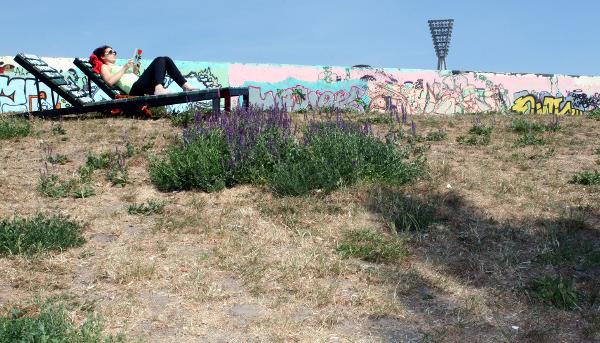
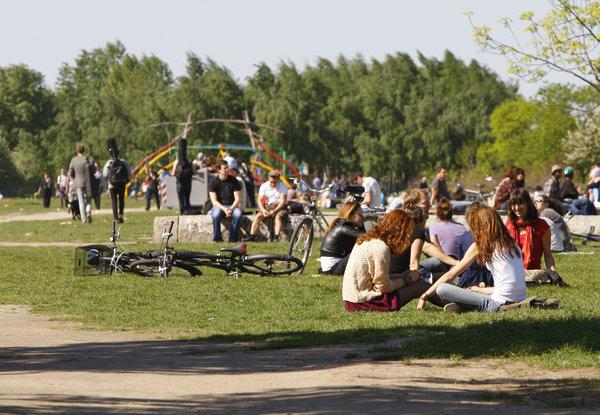
Where the death strip once ran between Prenzlauer Berg and Wedding, there are now almost 15 hectares of park. Behind the Friedrich-Ludwig-Jahn-Sportpark, about 300 meters of the original inner wall still stand, protected as a historic monument since 2001 and long covered in street art. Among Berlin Wall sites, Mauerpark is the most vibrant.
Mauerpark: From Death Strip to Open Space
Between Prenzlauer Berg and Wedding, the death strip, a heavily guarded no man’s land, ran here from 1961 to 1989. Before that, the area was the Nordbahn freight station. Even earlier, from 1820, the area served as a parade ground and in 1848 was the scene of the March Revolution; after 1914, allotment gardens and sports facilities were established here. Because the BFC Dynamo stadium directly on the border attracted large crowds, the GDR built the wall higher and smoother here than elsewhere and moved it further away from the death strip. In 1988, a new main wall was added without the old one being demolished. So, at the fall of the Wall, three walls stood side by side here.
Behind the Friedrich-Ludwig-Jahn-Sportpark, about 300 meters of the original inner wall still stand, distributed across three sections, made of long steel-reinforced concrete slabs between H-profile pillars. This remnant has been a protected monument since 2001, and today it is densely covered in street art. Cobblestones on the ground trace where the border ran.
Gustav Lange’s Design and Life in Mauerpark Today
The park was designed by Hamburg landscape architect Gustav Lange with the guiding principle of transforming the border area into an open space. The competition was decided in 1992, construction began in 1993, and the two eastern sections were completed in 1994. The expansion in June 2020 almost doubled the area to just under 15 hectares, again designed by Gustav Lange. Since 2017, the entire Mauerpark belongs to the Pankow district, and the Gleimtunnel, which was closed during the division, has been accessible again since 2008.
Today, the former death strip is home to large meadows, playgrounds, sports fields, a community garden, and an amphitheater. The flea market, with up to 170 private stalls spread over approximately 7,000 square meters of stand space, attracts thousands of people who browse vintage clothing, records, furniture, and handmade goods. In the amphitheater, Joe Hatchiban has been presenting his battery-powered karaoke to large audiences since 2009. A place of division has become one of the city’s most exuberant meeting points.

Top10 Redaktion
Erfahrungsbericht vom 22.10.2026
Price Level
Mauerpark is a public green space and accessible free of charge at all times.
Public Transport
U2 to Eberswalder Straße, from there Tram M1, M10, and 12. Trams M10 and 12 stop directly at the park at the Friedrich-Ludwig-Jahn-Sportpark stop.
Parking
No parking spaces are designated directly at the park; parking in the surrounding area is managed.
Highlight
Behind the Friedrich-Ludwig-Jahn-Sportpark, about 300 meters of the original inner wall still stand, protected as a historic monument since 2001.
Flea Market
The flea market takes place on Sundays on the former death strip, with up to 170 stalls spread over approximately 7,000 square meters.
Karaoke
In the amphitheater, Bearpit Karaoke takes place on Sundays in good weather, hosted by Joe Hatchiban since 2009.
Area
Just under 15 hectares after the 2020 expansion.
Accessibility
An accessible crossing leads via Schwedter Straße, and the paths at the Mauerblümchen playground are designed to be barrier-free.
Opening Hours
- Monday: Closed
- Tuesday: Closed
- Wednesday: Closed
- Thursday: Closed
- Friday: Closed
- Saturday: Closed
- Sunday: 10:00–18:00
Address
Bernauer Straße 63, 13355 Berlin, Deutschland