Karl-Marx-Allee
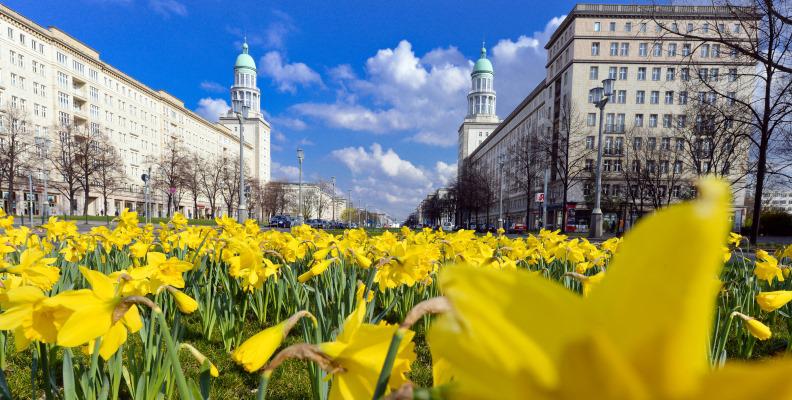
Karl-Marx-Allee stretches for about two kilometers from Frankfurter Tor to Strausberger Platz and is the largest preserved grand boulevard of the GDR. Hermann Henselmann's twin towers, the workers' palaces in socialist classicism, and the 1960s buildings such as Kino International and Café Moskau are now listed as an ensemble.
Karl-Marx-Allee in Friedrichshain: The Grand Boulevard of the GDR
On the Friedrichshain side, Karl-Marx-Allee stretches for about 2,100 meters from Frankfurter Tor to Strausberger Platz and continues for another 700 meters on the Mitte side, where it is 125 meters wide. The street dates back to 1708. Originally called Große Frankfurter Straße, it was renamed Stalinallee on December 21, 1949, and has borne its current name since November 13, 1961. The foundation stone for the extensive construction was laid on February 3, 1952; the high-rise building on Weberwiese had already been completed as a prototype in 1951, the last blocks were finished in 1967, and the Haus der Statistik was added in 1969. The avenue was planned by Hermann Henselmann, Hans Scharoun, Egon Hartmann, Richard Paulick, Hanns Hopp, Karl Souradny, and Kurt W. Leucht, among others. The architectural style is socialist classicism, incorporating elements of the Schinkel school and Berlin classicism, which is why the residential blocks were popularly known as workers’ palaces.
Twin Towers, Kino International and June 17, 1953
The most striking buildings stand at both ends. At Frankfurter Tor, Henselmann’s twin towers flank the street, their domes modeled after the towers of the German and French Cathedrals on Gendarmenmarkt. At Strausberger Platz stand the thirteen-story high-rises by the same architect with their Art Deco influences. In between are the ceramic-clad facades, and along the roadway, the original Paulick lights have been reconstructed since 2007. In the second construction phase towards Alexanderplatz, the lighter buildings of the 1960s follow, including Kino International, Café Moskau, and the Mokka-Milch-Eisbar (Mocha Milk Ice Bar). The street also made political history: on June 16, 1953, construction workers on the Stalinallee building sites began strikes against increased work norms, which a day later turned into a nationwide popular uprising. A small monument in the Rosengarten commemorates this. Karl-Marx-Allee is now a protected ensemble, with individual pavilions additionally protected as individual monuments, including numbers 32 to 36 and 45 and 46. A third construction phase connects to Alexanderplatz.

Top10 Redaktion
Erfahrungsbericht vom 26.10.2026
Price level
The walk is free, it is a public thoroughfare.
Public Transport
The U5 runs under the entire street, with stations at Frankfurter Tor, Weberwiese, Strausberger Platz, and Schillingstraße.
Route
The classic route leads from Strausberger Platz to Frankfurter Tor and is about two kilometers long.
Highlight
Hermann Henselmann's Twin Towers at Frankfurter Tor.
Architecture
Socialist Classicism from the 1950s, with 1960s modernism in the second construction phase.
Heritage Protection
The avenue is protected as an ensemble, with individual pavilions additionally protected as individual monuments.
Tip
The permanent exhibition at Café Sibylle at number 72 delves into the history of the street.
Opening Hours
- Monday: Open 24 hours
- Tuesday: Open 24 hours
- Wednesday: Open 24 hours
- Thursday: Open 24 hours
- Friday: Open 24 hours
- Saturday: Open 24 hours
- Sunday: Open 24 hours
Address
Karl-Marx-Allee, 10243 Berlin, Deutschland