The perfect Berlin experience:
Gift the Top10 Experience Box now!
Top10 Berlin

The best walks in Berlin 2026

54 Locations

A good walk is one of the best ways to know Berlin, a flat, green city made for wandering. From park strolls to canal side routes, a walk here reveals the city at its own pace. This overview gathers Berlin locations for stretching your legs.

The Tiergarten, Tempelhofer Feld and Treptower Park offer wide open strolls, while the canals, the Spree and the course of the former Wall make for scenic routes. The forests and lakes on the city's edge add longer rambles, and the neighbourhoods reward an aimless wander. A walk costs nothing and shows the city best.

Browse the venues below to plan a walk across Berlin in 2026, from park strolls to canal routes.

On the former Tempelhof marshalling yard, where the last train rolled in 1952, birches now grow between the tracks. The steam locomotive 50 3707, the water tower from 1927, and a 600-meter-long steel walkway provide strong motifs in Natur-Park Schöneberger Südgelände. For autumn photos in Berlin, this means: industrial culture amidst colorful foliage for 1 Euro entry.

See more

At 120.1 meters, Teufelsberg in Grunewald is Berlin's highest elevation and consists of approximately 26 million cubic meters of war debris, about a third of Berlin's rubble. Beneath the debris lies the demolished shell of a Nazi-era university, above stand the domes of the old listening station, and tobogganing takes place on its slopes.

See more

The Grunewald dog exercise area is the largest in the city and the only one whose boundaries you can truly see: Green wooden bollards mark where it begins. It extends from the upper hillside path north of the lakes to the railway line at the Avus. Dogs are allowed to run unleashed there all year round, but a two-meter leash rule applies to the shore paths below.

See more

Biesdorf Palace Park belongs to Biesdorf Palace, a late-classical tower villa from 1867, and was laid out as a landscape park from 1868. Across approximately ten hectares, large meadows alternate with dense tree groups, including the oldest continuous tree population in Marzahn. The park is a garden monument; grilling is not permitted here.

See more

Pichelswerder was once an island between Havel and Stößensee and only became a peninsula with the construction of the Heerstraße. Today, hillside paths lead over an artificial dam, and at the lighthouse at the tip, the Havel view opens up. Important for dog owners: Dogs are only allowed to run off-leash south of the Heerstraße here.

See more

The bicycle tour to Wannsee is the official cycling route RR1 and covers 28 kilometers from Schloßplatz in Mitte to Glienicker Bridge. Along the way are Gendarmenmarkt, Checkpoint Charlie, and Domäne Dahlem, with Wannsee Beach, boasting 1275 meters of sandy beach, at the destination. As a one-way tour, it can be easily combined with a return trip by S-Bahn.

See more

The Jungfernheide dog run area is located west of Bernauer Straße and north of the Waldidyll settlement in Tegeler Forst. It is pure forest land without a fence, where dogs are allowed to run off-leash as long as they remain recallable at all times. Do not confuse it with the fenced dog meadow in Volkspark Jungfernheide next door.

See more

The Grunewald toboggan hill on Onkel-Tom-Straße is the only hill on this list that is not a rubble hill: it belongs to an ice-age meltwater channel and is located in Fischtalpark, a garden monument from 1925. The first fifty meters or so are steep, while the lower section becomes wider and flatter, making it suitable even for small children.

See more

The Havelhöhenweg leads about 10 kilometers from Heerstraße to Wannsee Beach over the steep bank of the Havel in Grunewald. Along the way are the 55-meter-high Grunewald Tower, the Schildhorn peninsula, and numerous viewpoints overlooking the Havel. For an autumn stroll in Berlin, this means: golden foliage, water views, and constant ups and downs.

See more

The Frohnau dog exercise area is located at the southern end of Welfenallee in Tegeler Forst and goes by two names: Berliner Forsten lists it as Frohnau, while the Berlin district directory calls it Hermsdorf. It refers to the same unfenced forest area where dogs are allowed to run off-leash as long as they are recallable.

See more
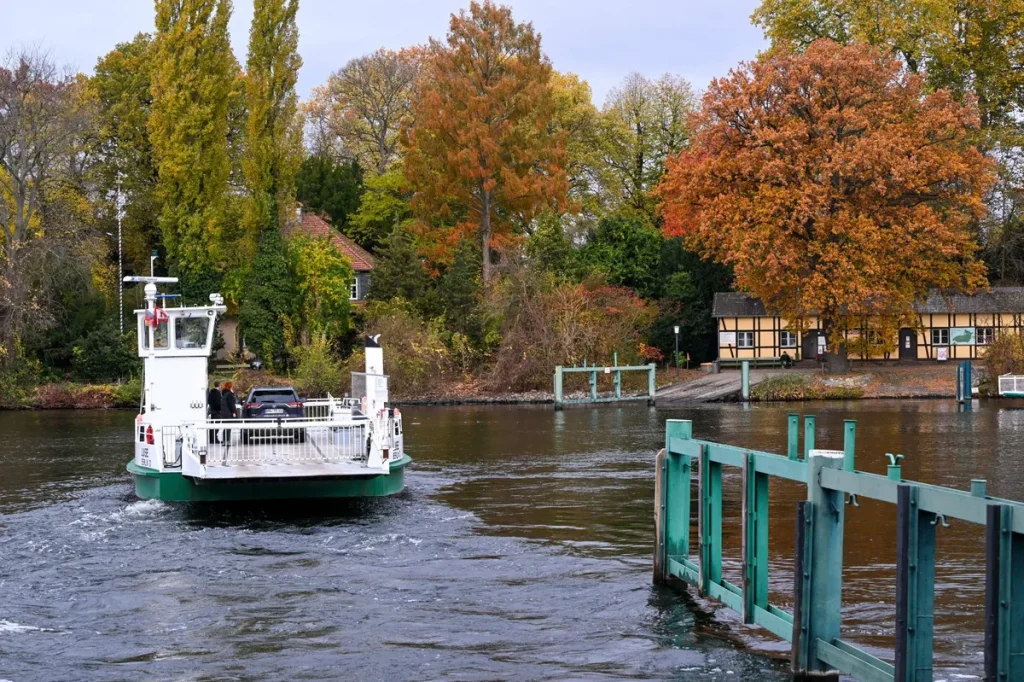
Fähre LUISE fährt mit Auto und Passagieren von der Pfaueninsel ab. Buntes Herbstlaub und gelbes Fährhaus am Ufer.

Peacock Island in the Havel near Wannsee is only accessible by ferry, a connection that has existed since 1821. On 67 hectares of UNESCO World Heritage, there are around 400 old oak trees, the white pleasure palace from 1794, and Berlin's oldest rose garden, with peacocks roaming freely in between. As an autumn excursion in Berlin, this means: golden foliage, water all around, and hardly any traffic noise.

See more

The Hakenfelde dog exercise area lies in the Spandauer Forst and is reached via Hubertusstraße. Behind the entrance at the Johannesstift, narrow paths lead through mixed forest and undergrowth, past two wildlife enclosures and the Kuhlaketeich. The area has been accessible since the 1920s, and there is no fence around it.

See more

The Hahneberg in Staaken is half nature, half rubble: originally 66 metres high, it was raised to 87 metres after the war with debris and construction waste. Inside lies the sunken Fort Hahneberg of 1888, a public observatory stands at 83 metres, and all around lie 37 hectares of nature and landscape conservation area.

See more

Volkspark Friedrichshain is Berlin's first municipal park, opened in 1848 and now covering 53 hectares. It features Ludwig Hoffmann's Fairy Tale Fountain, the two rubble hills Mont Klamott, and one of the city's few official barbecue areas. Among Berlin's parks, it offers the densest mix of history and everyday life.

See more
Our rating
4.6

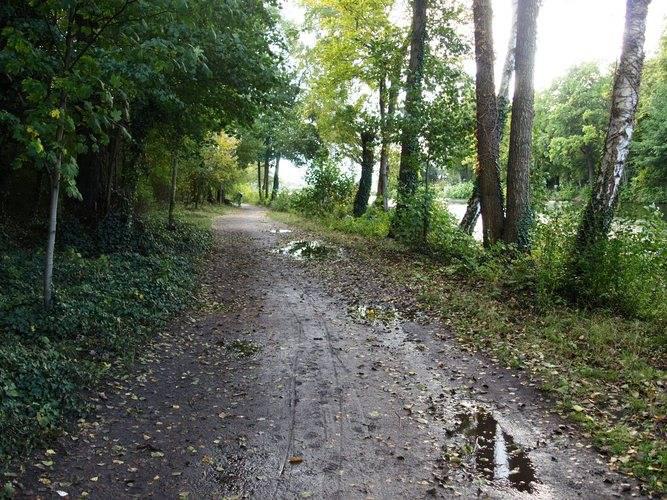
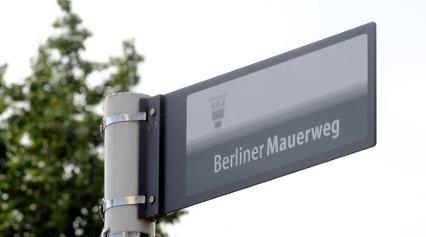
The Berlin Wall Trail is Berlin's most famous cycling tour: 160 kilometers on the former border strip, divided into 14 stages, all starting and ending at train stations. Over 40 information stations along the way tell the story of the division. It is not a fully developed cycle path; the surface alternates between asphalt, cobblestones, and forest floor.

See more
Our rating
4.5

Between the banks of the Spree and the Soviet Memorial in Alt-Treptow lies one of Berlin's largest parks. Gustav Meyer designed the 88-hectare park starting in 1876. Today, it hosts Germany's largest Soviet war cemetery, the Archenhold Observatory, and the Zenner guesthouse from 1822. World history and sunbathing lawns on the same stroll.

See more

The Wannsee-Düppel dog exercise area is a gently hilly stretch of woodland on the Pfaueninselchaussee, and one of the areas that give Steglitz-Zehlendorf its roughly 640 hectares, the largest share in the city. Bus 316 stops right on the corner. The Pfaueninsel directly opposite, however, is off limits for dogs entirely.

See more

The bike tour through Spandau's Old Town, lasting one to two hours, is one of Berlin's shortest cycling tours and leads from the market to the Spandau Citadel, a Renaissance fortress from 1594 with the 30-meter-high Juliusturm. Afterwards, it passes through the Kolk with its cobblestones and along the Lindenufer back. Easily manageable for children.

See more

The dog run at Geraer Ring 49 is the first public one of its kind in Marzahn-Hellersdorf, opened on July 5, 2026. Covering approximately 4,000 square meters, it features benches, waste bins, dog waste bag dispensers, and sluices for leashing and unleashing. This makes it better equipped than almost any other dog area in this city.

See more

The Rixdorfer Höhe in Hasenheide is a rubble mountain made from approximately 700,000 cubic meters of debris, piled up in 1951, 68 meters high and 22 meters above the surrounding terrain. The path leads spirally upwards, the descent requires attention, and at the foot of the mountain lies one of Berlin's largest animal enclosures.

See more
Photo: dpa picture-alliance
Photo: Top10 Berlin
Photo: dpa picture-alliance
Our rating
4.5

The Großer Tiergarten spans 207 hectares between the Brandenburg Gate and the Zoological Garden, making it Berlin's largest park. Peter Joseph Lenné transformed the old electoral hunting ground into a landscape park starting in 1818; today, the Victory Column, English Garden, New Lake, and Bellevue Palace are located within it. No other park in Berlin covers so much at once.

See more