Sledding Hill in Volkspark Humboldthain

The toboggan hill in Humboldthain Volkspark is not Humboldthöhe, but the small bunker hill on the southern edge of the park, grown over a blown-up anti-aircraft guidance tower. The large neighboring hill features the preserved combat tower with an observation platform, climbing wall, and bat quarters - and in Mitte, toboggan runs are no longer officially designated.
A Park from 1869 and Two Anti-Aircraft Towers
Humboldthain Volkspark in Wedding was started on September 14, 1869, the hundredth birthday of Alexander von Humboldt, was usable from 1872 and completed in 1876. Gustav Meyer, a student of Lenné, designed it; the 29 hectares are now protected as a garden monument. From 1941, two anti-aircraft towers completely changed the area: a combat tower and a guidance tower with a radar system, connected by a cable duct one and a half meters in diameter. Up to 3,200 people worked on the construction, including forced laborers and prisoners of war. The small guidance tower collapsed in 1947, and the large one was blown up twice by French pioneers in 1948; the two southern corner towers fell, the northern ones remained standing to protect the Ringbahn. By 1951, about 1.6 million cubic meters of rubble, delivered by rubble train, covered the debris. Günther Rieck designed the new park, topsoil was placed on the hills, and many young trees were planted because the old stock had been cleared. The Ascension Church, consecrated in 1893, blown up after the war, and rebuilt in the southern part in 1956, also bears witness to the park’s long history.
The Small Bunker Hill on the Southern Edge is the Toboggan Slope
Important for anyone coming with a sled: Tobogganing in Humboldthain Volkspark is not done on the 85-meter-high Humboldthöhe in the north, but on the small bunker hill on the southern edge, which was formed over the collapsed guidance tower. The address on Hochstraße leads directly there. However, since a 2021 resolution, the Mitte district no longer designates any toboggan runs in its green areas; the surfaces are only maintained as part of regular care. Tobogganing still takes place here, and when it snows, it’s very busy – nothing is supervised, use is at your own risk. The path to Humboldthöhe is worthwhile afterwards: On the top plate of the preserved combat tower is an observation platform with explanatory panels, from which, in clear air, the white radar domes of Teufelsberg can be seen. The outer walls of the northern towers are used by the German Alpine Club for sport climbing, around 250 bats hibernate inside, and the rose garden has about 15,000 roses of 70 varieties. Gesundbrunnen train station with S-Bahn, U8, and regional trains is right next door. The park also includes a summer pool with a fifty-meter basin, an adventure playground, and a water garden created in 1981.

Top10 Redaktion
Erfahrungsbericht vom 29.10.2026
Admission
Humboldthain Volkspark is freely accessible, tobogganing costs nothing.
Which Hill
Tobogganing is not done on Humboldthöhe in the north, but on the small bunker hill on the southern edge of the park, which was formed over the collapsed guidance tower.
Safety
Since a 2021 resolution, the Mitte district no longer designates any toboggan runs in its green areas. Tobogganing still takes place here, use is at your own risk.
The Slope
The slope has steeper sections and is less suitable for very young children. When it snows, it's very busy.
History
From 1941, a combat tower and a guidance tower with a radar system were built in the park. Up to 3,200 people worked on the construction, including forced laborers and prisoners of war. The guidance tower collapsed in 1947, and the large tower was blown up in 1948.
The Park
Started on September 14, 1869, the hundredth birthday of Alexander von Humboldt, designed by Gustav Meyer and completed in 1876. The 29 hectares are protected as a garden monument.
Humboldthöhe
The northern rubble hill measures 85 meters. On the top plate of the preserved combat tower is an observation platform with explanatory panels.
View
In clear air, the white radar domes of Teufelsberg can be seen from the anti-aircraft tower.
Climbing
The outer walls of the northern towers are used by the German Alpine Club for sport climbing.
Bats
Around 250 bats hibernate inside the combat tower. Guided tours through parts of the tower are possible with a helmet and last about 90 minutes.
Further Amenities
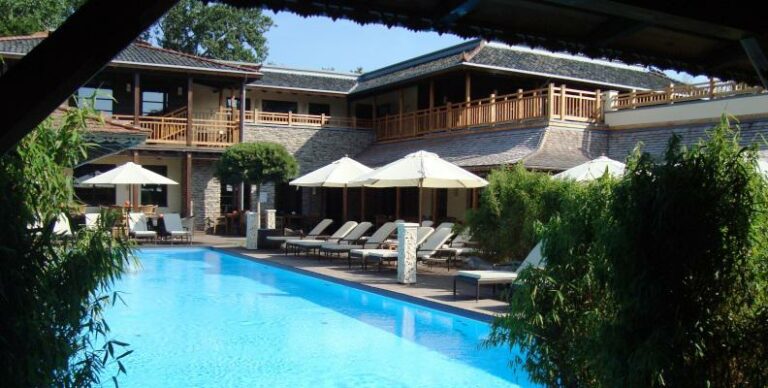
Rose garden with approximately 15,000 roses of 70 varieties, summer pool with a fifty-meter basin and a large slide, an adventure playground, and a water garden created in 1981.
Transport and Contact
Gesundbrunnen train station with S1, S2, S25, S26, S41, S42, U8, and regional trains is located directly next to the park, plus bus line 247. Hochstraße 7, 13355 Berlin.
Opening Hours
- continuously accessible: when there's snow
Address
Hochstraße 7, 13355 Berlin, Deutschland