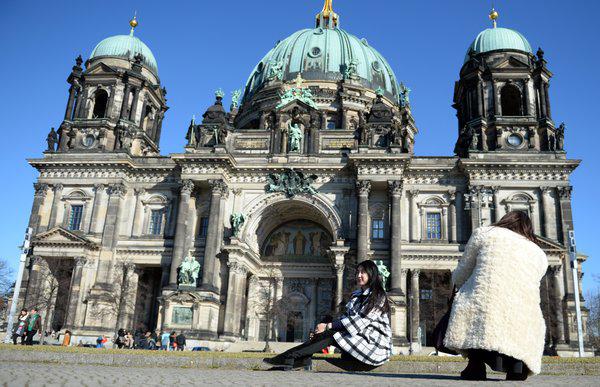
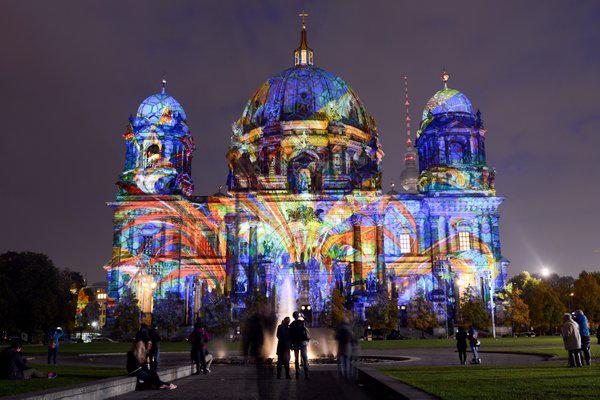
The Berlin Cathedral on Lustgarten was consecrated in 1905 according to plans by Julius Carl Raschdorff and features a 98-meter-high dome. Inside is the Great Sauer Organ with 7,269 pipes, and beneath it lies the Hohenzollern Crypt with 91 burials, which reopened in 2026 after six years of construction. 270 steps lead up to the dome walkway.
The Berlin Cathedral on Lustgarten: imperial architecture on the Spree
The Berlin Cathedral stands Am Lustgarten, opposite the Altes Museum and within sight of the Humboldt Forum, marking the south side of Museum Island with its four towers. Emperor Wilhelm II had it built between 1893 and 1905 according to plans by Julius Carl Raschdorff, after the previous building had been demolished. The Prussian House of Representatives approved ten instead of the hoped-for twenty million Reichsmark for it. The building was consecrated on February 27, 1905. Today, the dome reaches 98 meters, thus no longer its original height, because it was rebuilt in a simplified form after the destructions of the Second World War. The dome cross had to be removed in 2006 due to corrosion; a replica has been in its place since 2007. The dome mosaics were reconstructed according to the original templates until 2002, and the altar windows were restored until 1999. The sandstone facade, however, is severely damaged and is still awaiting comprehensive restoration, for which the cathedral community relies on donations and funding.
Sauer Organ, Hohenzollern Crypt, and the dome walkway at 50 meters
Inside, the Berlin Cathedral surprises with a splendor unusual for a Protestant church: Corinthian columns, mosaics, stained glass, gold, and marble characterize the preaching church. Its musical centerpiece is the Great Sauer Organ, inaugurated in 1905 by court organ builder Wilhelm Sauer from Frankfurt an der Oder. It has 7,269 pipes, 113 stops, four manuals, and pedals, and is considered the largest original preserved Late Romantic organ in Germany. Beneath the church lies the Hohenzollern Crypt with 91 burials from the late 16th to the early 20th century, one of Europe’s largest dynastic burial sites. After six years of construction, it will be accessible again in 2026, supplemented by its own crypt exhibition and a new crypt chapel. Upwards, 270 steps lead to the dome walkway at an approximate height of 50 meters, offering views over the TV Tower, Rotes Rathaus, and government district. From January 2027, the Sauer Organ will be restored: approximately 7,500 handmade leather bellows will be replaced, and all pipes will be cleaned and tuned. Admission costs 15.00 Euros, reduced 12.00 Euros, and the audio guide is included.

Top10 Redaktion
Erfahrungsbericht vom 28.10.2026
Price Level
Admission costs 15.00 Euros, reduced 12.00 Euros. Audio guide and dome walkway are included.
Public Transport
Museumsinsel U-Bahn station (U5), Hackescher Markt S-Bahn station (S3, S5, S7, S9), Tram M4, M5, M6 to Spandauer Straße, as well as bus 100 and 300.
Parking Facilities
There are no private parking spaces. Multi-storey car parks are located on Karl-Liebknecht-Straße and at the Staatsoper (State Opera), disabled parking spaces are on Am Lustgarten.
Accessibility
Since 2026, the Preaching Church, Baptismal and Wedding Church, Hohenzollern Crypt, Cathedral Museum, Cathedral Shop, and Cathedral Café are barrier-free. Due to structural reasons, the dome walkway is not wheelchair accessible.
Dome Walkway
270 steps lead to the walkway at an approximate height of 50 meters. There is no elevator to the dome; sturdy footwear is recommended.
Luggage
Bags and luggage larger than DIN A3 are not permitted. The number of lockers in the basement is limited.
Highlight
The Great Sauer Organ from 1905 with 7,269 pipes and 113 stops.
Opening Hours
- Monday: 09:00–18:00
- Tuesday: 09:00–18:00
- Wednesday: 09:00–18:00
- Thursday: 09:00–18:00
- Friday: 09:00–18:00
- Saturday: 09:00–17:00
- Sunday: 12:00–17:00