Flughafen Tempelhof
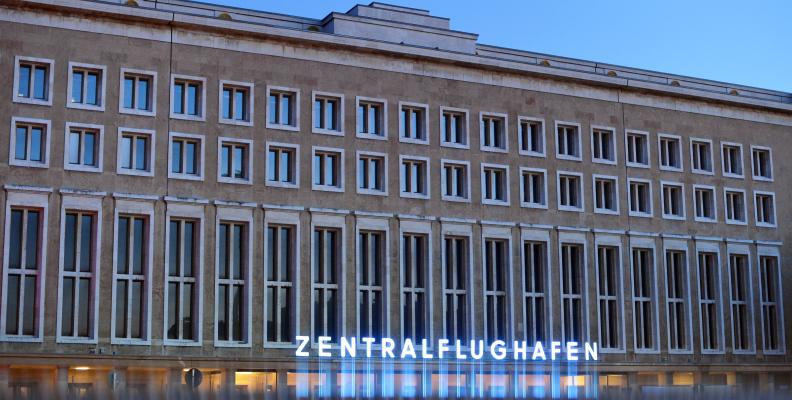
At Platz der Luftbrücke stands Tempelhof Airport, Europe's largest architectural monument, built from 1936 as a prestige project of the National Socialists. In 1948, the 'Raisin Bombers' of the Berlin Airlift landed here, after which the US Air Force used the site until the end of the Cold War. Guided tours lead through hangars, bunkers, and transit passages.
Tempelhof Airport: Airlift and Cold War in one place
The Berlin-Tempelhof Airport is Europe’s largest architectural monument and has been a symbol of German engineering since 2011. The building is far more than just an architectural sensation. From 1936, the world’s largest contiguous airport building was constructed here, its dimensions matching the National Socialists’ claim to grandeur. Anyone walking through the monumental halls immediately feels this.
However, the history of the place is multifaceted. Tempelhof gained worldwide fame during the Berlin Blockade of 1948: While the Soviet Union cut off all land and water routes to West Berlin, hundreds of aircraft landed here daily, bringing food, coal, and essential goods to the blockaded city. Under the keyword „Raisin Bombers”, the operation became a founding myth of West Berlin.
Guided Tours and Permanent Exhibition: Experience German-German History
Today, the former airport is a living historical monument with various tour formats. The „Myth of Tempelhof” tour leads to the most interesting places in the imposing building, from the former departure hall to the areas used by the Americans and the transit passages. Particularly impressive is the „Hidden Places” tour, which offers moving insights into its use during National Socialism and by the US Air Force during the Cold War.
Additionally, a new format has been available since early 2025: The short tour „THF in 60 Minutes” is particularly suitable for spontaneous visitors or people with limited mobility. The permanent exhibition in the CHECK-IN visitor center, developed by the Topography of Terror Foundation, highlights the airport’s construction as a prestige project of the National Socialists, its role during the Berlin Airlift, and recalls the old airport as a hub in an early Europe-wide transport network. Anyone seriously interested in German-German history should not only visit Tempelhofer Feld but also explore the depths of the building.
Airlift Memorial: The Landmark in front of Tempelhof Airport
At Platz der Luftbrücke in front of the former airport building stands the Airlift Memorial by Eduard Ludwig, affectionately called „Hungerharke” (Hunger Rake) by Berliners. With its three westward-pointing ribs, the 20-meter-high monument symbolizes the three air corridors through which West Berlin was supplied during the blockade. Even those who don’t book a guided tour will find a moment for reflection here.

Top10 Redaktion
Erfahrungsbericht vom 26.10.2026
Price Level
The „Myth of Tempelhof" tour costs 17.50 Euros, reduced 12 Euros. The short tour „THF in 60 Minutes" costs 12 Euros, reduced 9 Euros.
Public Transport
U6 to Platz der Luftbrücke or Paradestraße, S41, S42, and S46 to S Tempelhof.
Parking Facilities
No dedicated parking spaces. Arrival by public transport is strongly recommended.
Highlight
The 1,230-meter-long hangar and apron arc, the 380-meter-long pier, and the „Hidden Places" tour through air-raid shelters and film bunkers.
Airlift
Between June 26, 1948, and October 6, 1949, nearly 278,000 flights brought more than 2.3 million tons of goods to West Berlin.
Meeting Point
All tours start at the CHECK-IN visitor center at Platz der Luftbrücke, about a five-minute walk from the subway station.
Accessibility
The „Hidden Places" tour is not barrier-free due to long distances and many stairs. Wheelchairs, rollators, and strollers are not permitted there.
Opening Hours
- Monday: 10:00–17:00
- Tuesday: Closed
- Wednesday: 10:00–17:00
- Thursday: 10:00–17:00
- Friday: 10:00–17:00
- Saturday: 10:00–17:00
- Sunday: 10:00–17:00