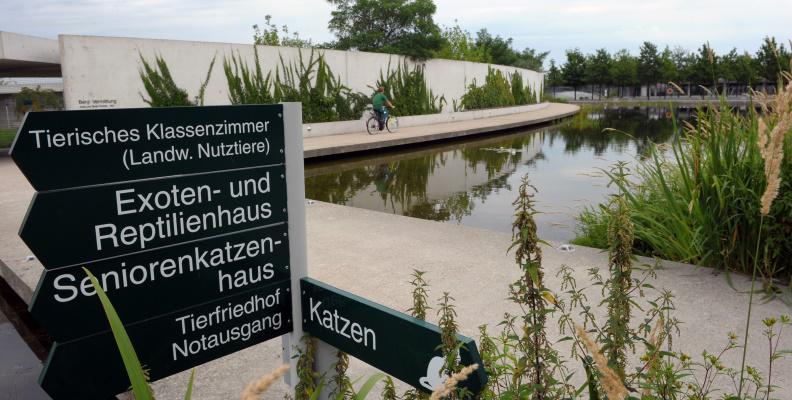
On 16 hectares in Falkenberg, there is a complex made of exposed concrete with over two hundred individually shaped round columns, large water features, and a circular outdoor area of approximately 210 meters in diameter, housing fifteen dog pavilions. Dietrich Bangert designed it, and productions like Aeon Flux use it as ready-made futuristic architecture.
Exposed Concrete and Water Features in Falkenberg
The Berlin Animal Shelter is located at Hausvaterweg 39 in Falkenberg, in the far northeast of the city, on a 16-hectare site. You can reach the “Tierheim Berlin und Dorfstraße” stop by taking the S7 to Ahrensfelde or the S75 to Hohenschönhausen, then bus 197; from Alexanderplatz, take tram M4 to the Falkenberg terminus, from there the same bus continues. It’s just under a ten-minute walk from the stop. The complex was designed by Berlin architect Dietrich Bangert, built around the turn of the millennium, and officially opened in 2002. It is run by the Animal Welfare Association for Berlin and Surrounding Areas, founded in 1841. The entire site is barrier-free, and the paths are wide enough for wheelchairs and strollers. The complex is divided into two long buildings for administration, small animals, and cats, as well as the circular area for dogs. In between are ponds, oaks, and paths that deliberately avoid dead ends, so that animals and visitors do not feel cornered.
Why Science Fiction Films Here of All Places
Architecturally, the animal shelter is a unique structure: exposed concrete, over two hundred individually shaped round columns, curved balustrades, large water features, and a circular outdoor area of approximately 210 meters in diameter, housing fifteen round dog pavilions. Precisely this austerity makes the location a film set for stories that want to depict the future or a laboratory. For Aeon Flux in 2005, the complex served as a model and filming location for a fictional complex; in the Tatort episode “Leiden wie ein Tier” (Suffering Like an Animal) in the same year, it became the Institute for Experimental Molecular Medicine, and a ten-part television series was filmed entirely here. If you wish to visit, please call in advance; groups of eight or more can register for a guided tour. The film set aspect remains secondary, as the facility takes in several thousand animals each year. Additionally, there is an animal clinic, an animal cemetery, and a dog playground, all part of the same design. Productions especially value that indoor and outdoor shots can be combined here without reconstruction, as the architectural language is consistent throughout.

Top10 Redaktion
Erfahrungsbericht vom 26.10.2026
Admission
Admission is free. Guided tours are arranged for groups of eight or more people.
Contact
Before visiting for animal adoption, call 030 76 888 0. Guided tours for adults: 030 76 888 122; for children, teenagers, and school classes: 030 76 888 234.
Public Transport
S7 to Ahrensfelde or S75 to Hohenschönhausen, then Bus 197. From Alexanderplatz, Tram M4 to Falkenberg, then Bus 197. Stop: Tierheim Berlin und Dorfstraße, from there approx. a ten-minute walk.
Arrival by Car
Via Ahrensfelder Chaussee or Falkenberger Chaussee, approx. thirty-five minutes from the eastern city center and fifty minutes from the western city center.
Architecture
Designed by Dietrich Bangert, exposed concrete, over two hundred individually shaped round columns, sixteen hectares of grounds, circular dog area approx. 210 meters in diameter with fifteen pavilions.
Accessibility
The entire site is barrier-free.
Film References
Aeon Flux from 2005, the Tatort episode "Leiden wie ein Tier", and a ten-part television series about the facility.
Operator
Animal Welfare Association for Berlin and Surrounding Areas, founded 1841.
Opening Hours
- Tue: 13:00 – 16:00
- Wed: Closed
- Thu: 13:00 – 16:00
- Fri: Closed
- Sat: 13:00 – 16:00
- Sun + Mon: Closed