
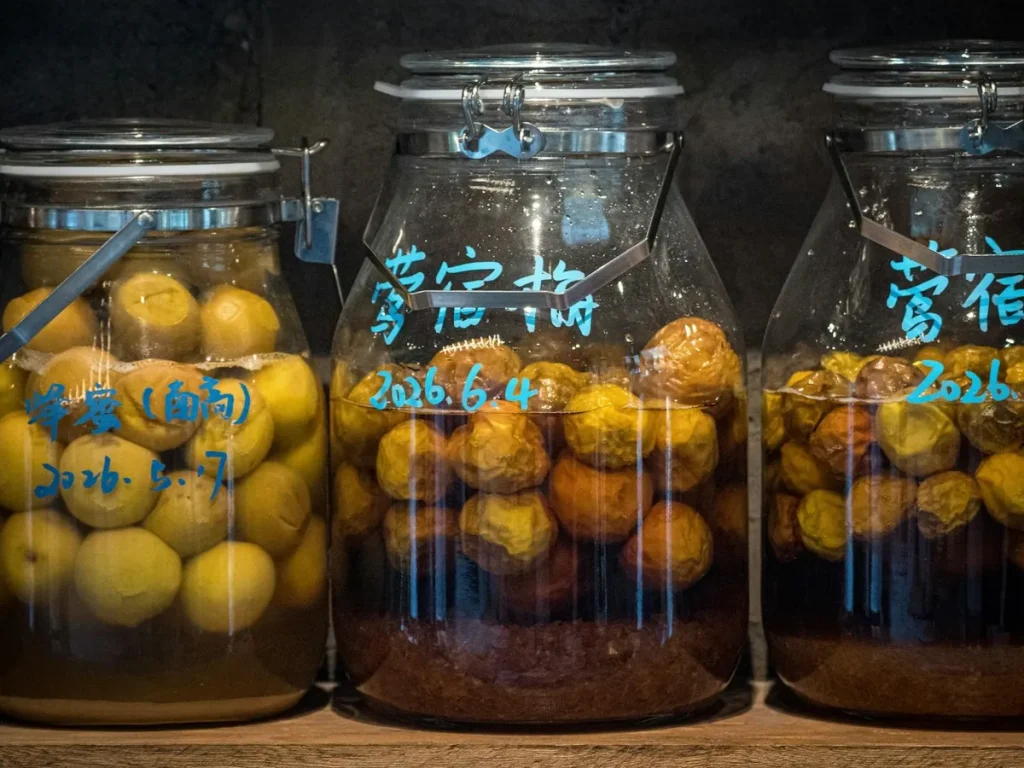
In the Osram-Hoefe in Wedding, mimi ferments makes Japanese ferments no large producer would supply this way: miso, shoyu, koji and gochujang, none of them pasteurised and some matured in barrels for years. Markus Shimizu supplies starred kitchens across half of Europe with them, and the shop runs workshops on making your own.
A fermentation workshop in a former light bulb factory
mimi ferments works at Oudenarder Strasse 16 in Wedding, in a ground floor room of the Osram-Hoefe. The site was once the largest light bulb factory in Europe: from 1904 the Bergmann electricity works produced the first German light bulbs here, in 1935 Osram took the grounds over, and in the best years around five and a half thousand people worked behind these yellow brick facades. Since production left, the buildings have stood under monument protection and house around sixty businesses and institutions. A tower with a clock face from the factory years still stands, and that face has only one hand. All around lies the quarter by Leopoldplatz with one of the best preserved stocks of pre-war buildings in the district, and on Liebenwalder Strasse stands the oldest house in Wedding, dating from 1875. The workshop was founded in 2017 by Markus Shimizu, who was born in Tokyo, studied art in The Hague and at the Weissensee art academy and taught himself to ferment. He began with workshops before anything was produced at all.
Koji in the barrel, and nothing pasteurised
At mimi ferments everything begins with koji, a mould that grows on grain and breaks down carbohydrates and proteins. For miso, short grain rice is steamed, inoculated with koji, fermented for two days at around thirty degrees and then mixed with cooked soya beans and salt; after that the mass matures for anything from a few weeks to several years. For shoyu, grain is roasted and cracked, soya beans are steamed, both are inoculated and then laid in salt water. Around seventy barrels rest in the workshop, among them used red wine, whisky, bourbon and rum barrels that give off aromas of their own, alongside clay jars and ceramic. What matters is what does not happen at the end: not a single ferment is pasteurised, so all of them stay alive and keep changing. A jar of shiro miso costs 12.90 euros and gochujang 16.90 euros. The customers include starred kitchens such as Nobelhart und Schmutzig, Facil and Coda, and for individual houses special batches are made, among them a garum from chicken and a fish sauce from langoustine heads.

Top10 Redaktion
Erfahrungsbericht vom 28.10.2026
Price level
A jar of shiro miso of two hundred grams costs 12.90 euros, ama miso 13.90 euros and gochujang 16.90 euros. A spelt soy sauce comes to 18.90 euros and an aroma box to 72 euros.
The range
Miso at several stages of maturity, shoyu and garum, koji and mirin, natto, amazake and gochujang, alongside starter sets for fermenting at home and koji-based cosmetics.
The basis
Everything begins with koji, a mould that grows on grain and breaks down carbohydrates and proteins. Miso, shoyu and amazake all grow out of it.
Maturing times
Miso matures from a few weeks to several years, soy sauce usually one to three years. The oldest barrel was recently around three and a half years old.
The barrels
Around seventy rest in the workshop, among them two hundred litre wine barrels as well as used red wine, whisky, bourbon and rum barrels, alongside clay jars and ceramic.
Unpasteurised
Not one ferment is pasteurised. The products stay alive and keep changing, which is why the house gives its own notes on keeping and storage.
Ingredients
Certified organic ingredients, where possible straight from farmers in the region, with no additives.
Workshops
There are workshops on miso and vegetable ferments, bookable online and on request for groups and whole kitchen teams.
Salon mimi
Four times a year the workshop invites guests to an art dinner that joins installation, performance and food. The evenings are curated by Reiko Kanazawa.
Founded
In 2017 by Markus Shimizu, born in Tokyo, trained as an artist and self-taught as a fermenter. The first site was in Moabit.
Customers
Starred kitchens in Germany, Austria, Italy, the Netherlands and Belgium are supplied, among them Nobelhart und Schmutzig, Facil and Coda.
The site
From 1904 the Osram-Hoefe held the works of the Bergmann electricity company and later the largest light bulb factory in Europe. The brick buildings stand under monument protection today.
Transport
The stations Seestrasse and Nauener Platz are within walking distance, and the tram stops at Wilhelm-Hasenclever-Platz.
Address
Oudenarder Strasse 16, Haus C7, 13347 Berlin.
Opening Hours
- Monday: 10:00–18:00
- Tuesday: 10:00–18:00
- Wednesday: 10:00–18:00
- Thursday: 10:00–18:00
- Friday: 10:00–18:00
- Saturday: Closed
- Sunday: Closed


